Starting tomorrow, I will have a new title: Trainer. I am very excited about this and am anxiously awaiting to see what this year brings. So I send out this question to you:
If your company were to tell you that there is a trainer available to help you with anything you need, at no cost to you, and available to help you in any way possible; both in class and/or out of the classroom, what would you want to be trained better in?
Leave a comment and let me know. This will also help me to know what you want to see more posts on as well as possible trainings to provide at various conferences.
6/30/2008


6/29/2008
Preschool Graduation Activities
Okay, as promised, a review of our carnival. This year was tough for volunteers, but next year I have a better plan. Add to that, one of the teachers had accidentally tossed the carnival box when she was cleaning out the staff room and I didn't discover this until the day before the carnival. YIKES! It was totally my fault, I didn't label the box and just assumed people would know what it was...NEVER ASSUME!
Needless to say, I spent the entire day on Thursday recreating all the booths. Plus, making all the name tags and don't forget dealing with the portrait place. I managed to get all the parents free pictures from a local store (their affiliate store) and one 5x7 cap and gown picture each. So, I put those into the nice framed 'diploma books' for them.
We had a HUGE turnout. I had less graduates this year and more attendance. My cook made 180 hot dogs, there were 10 left. I know not everyone ate and I didn't count, but I am putting the attendance number at around 150.

This picture is just from the beginning as people were starting to come in.
I didn't have a projector screen, but I had a projector to play a slide show off the computer. I bought a white sheet and was going to have it up between the two poles you see in the back right of the picture. Well, when we had it all up, you couldn't see it. Good thing we tried it out earlier. So, we quickly went to plan B and put the sheet over some dark blue butcher paper on the window and used that is the front of everything.
It was difficult to get every one's attention when we were ready to start so I will have to look at a way to fix that next year. I tried even to sing some children's songs and get them involved, but it still didn't quiet everyone. Once I got through my very short talk about thank-you-for-trusting-us-with-your-child's-education and all that, I showed the slide show...silence everywhere. They loved it!
After the slide show was the pledge allegiance and then to the games!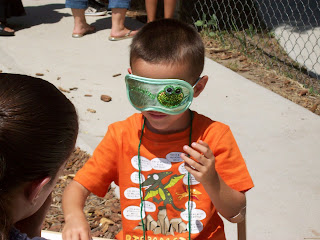
This was actually a last minute change to a boring sorting game. I walking in the other day and saw my 3 year old assistant teacher blindfolding children to do simple puzzles and thought that this would be a hit...and it was a HUGE hit. The children loved it!
 Yes, I know this pictures fuzzy, but can you see the name tag hanging? On the back are 10 squares that they are supposed to put stickers in each square after they complete a game. It doesn't matter that they do the same activity 10 times or 10 different activities. Once their 10 squares are filled they can come to the prize booth and pick up their diploma and prizes. One of the booths was actually to write their name on their name tag.
 I also had available name tags for the siblings. This is supposed to be a day of fun for everyone as well as a celebration and farewell party for the graduates; so everyone gets to participate.
Once everyone had started and were involved in the games, I went over to the pictures. Parents were able to look through the packages of pictures and purchase them right then. This is a huge advantage because the grandparents are there who want to buy the pictures too and we get kickbacks from the sales! I was also there to pass out the prizes to the children when they came up.
The prizes were: their diplomas, stickers, and a CD that had all the pictures we had ever taken at the center with them in it as well as a copy of the slide show. Last year we had more donations so the prize bags were better, but each year is different. I also had extra sheets of stickers for the siblings as well.
People stayed around for close to three hours. Much longer than any of the traditional graduations; but way better. The families had a great time just hanging out! This is totally the way to go. I think people had much more fun, and it's so much more appropriate. I had one particular person who works with me (someone with no child development experience or knowledge) who kept making comments all week about "how important this is for the families" and basically didn't like that I wasn't doing a graduation ceremony. It was like beating my head against a wall trying to explain to her that this is about the children and what is appropriate to do with them. Anyway, in the end, after all was done, she did say that it was fun...but she still thinks that we should have done a ceremony because "it would have been easier". Glad I don't always look for the easy, but the best.
Next year I will have to work at getting more volunteers because I think this years activities were perfect: the perfect number and type. Next year I would like to up the stakes and maybe have a face painter, someone to come do some songs or storytelling, and make it even bigger. I would love to have this take off as a huge event!
Anyone want to share their preschool graduation experiences? What do you do?
6/28/2008
Book of the week-Let's Get Ready For

Let's Get Ready for Kindergarten! and Let's Get Ready for First Grade! are by Linda Desimowich and Stacey Kannenberg and were sent to me to review this past week. As a preschool teacher (okay administrator-turned-trainer- in-two-days, but I did get here from somewhere right!?!) I was anxious to get these books. I didn't know what to expect. So many people try and create a book that does it all for the children. Let's cram everything they need learn in a year into one book, right? Well, these books do that, but in a very good way. I like them.
My favorite thing? The pages are sturdy and slick! When a child write in it with a crayon or marker (and they probably will) it is real easy to wipe off. (I don't know that from me doing it, I know that from other books made out of this material). And actually, in both books, there are places in the book made just for writing in. I personally would use a dry erase marker for easier clean up, but that's up to you.
They did a great job with the writing. One of my pet peeves is that so many "educational" books for children write everything in CAPITAL LETTERS! This is not how words are supposed to be. They need to learn the lower case (and actually should learn lower case first if you want to choose one or the other; we do them both at the same time. The words are all written correctly and the drawings are recognizable.
In the classroom, I wouldn't use these books at circle time. I would put them out in the library, or, better yet, on the writing table. It is a great book to sit down one on one with a child and bring them back into focus.
This book was obviously a collaborative effort between many people, but there is no picture. Being that this book isn't read at circle time, I can forgive them for not putting any pictures of the author's in it. However, in case you want to still introduce the author to the children, I did find a picture of Stacey (couldn't find any of Linda-send one to me if you want).
Things to come
I know, I didn't write about the challenging behaviors, but it is coming...today...I promise. I will back date it so make sure to check for it.
I will also be reviewing not one, but two books today. Why? Because they will be part of an upcoming contest! That's right, we are going to have our first contest with two winners! I have two books to give away.
And why did I fall behind this week? It was the great graduation carnival that's why! I know you will all want an update as to how that went, so I will be writing about that as well.
So there you have it: 4 fabulous posts to come! But, they take time to write to make so fabulous. These words don't just jump on the page by themselves; but first is going to have to be the challenging behaviors. This week we are talking about personal space needers.
I will also be reviewing not one, but two books today. Why? Because they will be part of an upcoming contest! That's right, we are going to have our first contest with two winners! I have two books to give away.
And why did I fall behind this week? It was the great graduation carnival that's why! I know you will all want an update as to how that went, so I will be writing about that as well.
So there you have it: 4 fabulous posts to come! But, they take time to write to make so fabulous. These words don't just jump on the page by themselves; but first is going to have to be the challenging behaviors. This week we are talking about personal space needers.
6/27/2008
Challenging Behaviors-Personal Space
Okay, I want to prefice this post by telling a quick story:
When I first encountered my first special needs child in my classroom (she was diagnosed with Pervasive Development Disorder-Not otherwised specified or PDD; basically one of many forms of autism). Anyway, my brother works with people of all ages with all sorts of special needs and is very well known in his field; so of course I turned to him for some help. When I asked him what I needed to do he replied, "Follow her lead and start from where she is at developmentally. Sit back and observe and give her the tools she needs. Find how she learns best and start from there." (okay, that isn't word for word, it was over 5 years ago, but it is pretty close). My response (which is exactly word for word), "Okay, but what do I do for her that is different that what I am already doing for everyone else in the classroom." We went back and forth in our conversation until we finally came to the same conclusion: what he does for special needs children is what I do for all young children: take them for who they are, appreciate them for that, and follow their lead in providing learning opportunities for them.
As you know by now, I will do what is best for one individual child, even if I wouldn't do it for all; but I would do the same things for any of them. Does that make sense when you read it? It makes sense when I say it; but looks odd in writing. Maybe I need to record the message.
Now on to today's challenging behavior:
We have a child (let's go with Katie, remember I use different names for confidentiality). Katie likes to have her own space and gets very aggressive in behavior when people come in to the space that she doesn't know or possibly trust. She allows her parents and her teacher to come into her space frequently. The assistant teacher has just recently been able to break this space barrier without her losing control. Some of the other classmates are allowed in her space, but not everyone; actually it's only a rare 2 or 3 that are consistently allowed in. The frustration with the teacher is that she never knows which child will be let in or what is going to make her lose control.
By lose control, the teacher means: pushing them away to throwing things at them. It seems to escalate as it progresses. She'll start with a simple motion or even a disgruntled sound but if the other person doesn't read this clue, then she will escalate until she gets her message across.
I want to note here that there are no stressors in her life that would show cause for her to need her own space. This just seems to be part of her personality. And, though she may have other developmental problems (autism, or other such diagnosis) those haven't been diagnosed nor do they come into play in how to help her; as I mentioned above, it is the same thing I would do for any child.
Katie needs to be able to function in a classroom setting in order to be successful. She is four and will be going to Kindergarten in '09; so there is some work to be done, but it is possible. If Katie can be successful in Kindergarten in a group setting, she will be successful in life. So how do we help her?
First, I would teach all the children about personal space and allowing others into their space as well as how to let other's know to get out of their space. Do some role playing at circle time. Have two children sit in front of everyone very close together. Instruct one child to turn to the other and say, "You are too close to me. I need more space. Please move over." When they move over try a new group of children. This time, the other child doesn't move; instruct the speaking child to move themselves. If you practice it at circle, they will be able to practice it in the classroom. This will also give Katie some visual help in how to better deal when someone doesn't listen or notice her subtle cues. Make sure that Katie is one of the volunteers to practice at circle time.
Katie may not join circle, and that's okay. Give her a space just outside of circle if she can handle that, or even set up a quiet activity at the table for her to do during circle. Keep an eye on her, she will be participating just at a distance. I had one child who would sit at the table during circle with some puzzles and books. One day, while asking questions about the book I was reading, he piped up the answer. So, even though she isn't right there, she will be benefiting. If you allow her to join circle when she is ready to handle it, there will be much more success.
Obviously small spaces are a problem as well. If things are getting too crowded at the sensory table, put some of the supplies in a smaller tub at the table. This will allow her to participate but have her own space. And yes, if other children want too do this as well, it is just fine. Maybe as she progresses she will be able to share this smaller tub with one other child.
As the teacher, you also need to be aware of her smaller cues. Can you be with her 100% of the time? No, you have too many other's that need your attention as well. But any successful teacher is able to keep an eye or ear on everything; I call it global awareness: the ability to close your eyes in a classroom and know exactly where every child is and what they are doing and where you need to go first. So, when you begin to see or hear these cues, tell the person: "Sally, Katie is pushing you with her hands, that means you're in her space. Katie, remember to say you are in my space please move." Just as Katie needs to learn these words to use, Sally needs to learn the cues. These are cues that people need in order to be successful. Do you know when a good time to ask your boss for a day off is by her body cues? I'm guessing you do. It's a social skill.
Don't just remind children, remind adults. If your assistant teacher needs it, just mention, "Miss J, I see Katie is pushing your leg away, this is a cue." Or, even the other parents, "Mrs. Smith, Katie is asking you to move away from her chair. Please move, she needs some more space." When Mrs. Smith rolls her eyes or makes a snide comment be sure to call her out on it. "We are teaching all the children to respect every ones space and to read other people's body cues. It's important in our environment that they know that others will respect them."
This situation with Katie will be fixed and pretty easily with very little effort; but it will take time...and space. Allow her to have her own space; we all need our own space. Allow all the children to have their own space.
One last note: Create several spaces in the classroom where children can get away. A refrigerator box to crawl into to get away, a table for one set up in a corner to be able to turn your back on the room and get involved in your own task, large pillows set up in a corner with a personal CD player with headset...
What are some personal space ideas you use at your centers?
When I first encountered my first special needs child in my classroom (she was diagnosed with Pervasive Development Disorder-Not otherwised specified or PDD; basically one of many forms of autism). Anyway, my brother works with people of all ages with all sorts of special needs and is very well known in his field; so of course I turned to him for some help. When I asked him what I needed to do he replied, "Follow her lead and start from where she is at developmentally. Sit back and observe and give her the tools she needs. Find how she learns best and start from there." (okay, that isn't word for word, it was over 5 years ago, but it is pretty close). My response (which is exactly word for word), "Okay, but what do I do for her that is different that what I am already doing for everyone else in the classroom." We went back and forth in our conversation until we finally came to the same conclusion: what he does for special needs children is what I do for all young children: take them for who they are, appreciate them for that, and follow their lead in providing learning opportunities for them.
As you know by now, I will do what is best for one individual child, even if I wouldn't do it for all; but I would do the same things for any of them. Does that make sense when you read it? It makes sense when I say it; but looks odd in writing. Maybe I need to record the message.
Now on to today's challenging behavior:
We have a child (let's go with Katie, remember I use different names for confidentiality). Katie likes to have her own space and gets very aggressive in behavior when people come in to the space that she doesn't know or possibly trust. She allows her parents and her teacher to come into her space frequently. The assistant teacher has just recently been able to break this space barrier without her losing control. Some of the other classmates are allowed in her space, but not everyone; actually it's only a rare 2 or 3 that are consistently allowed in. The frustration with the teacher is that she never knows which child will be let in or what is going to make her lose control.
By lose control, the teacher means: pushing them away to throwing things at them. It seems to escalate as it progresses. She'll start with a simple motion or even a disgruntled sound but if the other person doesn't read this clue, then she will escalate until she gets her message across.
I want to note here that there are no stressors in her life that would show cause for her to need her own space. This just seems to be part of her personality. And, though she may have other developmental problems (autism, or other such diagnosis) those haven't been diagnosed nor do they come into play in how to help her; as I mentioned above, it is the same thing I would do for any child.
Katie needs to be able to function in a classroom setting in order to be successful. She is four and will be going to Kindergarten in '09; so there is some work to be done, but it is possible. If Katie can be successful in Kindergarten in a group setting, she will be successful in life. So how do we help her?
First, I would teach all the children about personal space and allowing others into their space as well as how to let other's know to get out of their space. Do some role playing at circle time. Have two children sit in front of everyone very close together. Instruct one child to turn to the other and say, "You are too close to me. I need more space. Please move over." When they move over try a new group of children. This time, the other child doesn't move; instruct the speaking child to move themselves. If you practice it at circle, they will be able to practice it in the classroom. This will also give Katie some visual help in how to better deal when someone doesn't listen or notice her subtle cues. Make sure that Katie is one of the volunteers to practice at circle time.
Katie may not join circle, and that's okay. Give her a space just outside of circle if she can handle that, or even set up a quiet activity at the table for her to do during circle. Keep an eye on her, she will be participating just at a distance. I had one child who would sit at the table during circle with some puzzles and books. One day, while asking questions about the book I was reading, he piped up the answer. So, even though she isn't right there, she will be benefiting. If you allow her to join circle when she is ready to handle it, there will be much more success.
Obviously small spaces are a problem as well. If things are getting too crowded at the sensory table, put some of the supplies in a smaller tub at the table. This will allow her to participate but have her own space. And yes, if other children want too do this as well, it is just fine. Maybe as she progresses she will be able to share this smaller tub with one other child.
As the teacher, you also need to be aware of her smaller cues. Can you be with her 100% of the time? No, you have too many other's that need your attention as well. But any successful teacher is able to keep an eye or ear on everything; I call it global awareness: the ability to close your eyes in a classroom and know exactly where every child is and what they are doing and where you need to go first. So, when you begin to see or hear these cues, tell the person: "Sally, Katie is pushing you with her hands, that means you're in her space. Katie, remember to say you are in my space please move." Just as Katie needs to learn these words to use, Sally needs to learn the cues. These are cues that people need in order to be successful. Do you know when a good time to ask your boss for a day off is by her body cues? I'm guessing you do. It's a social skill.
Don't just remind children, remind adults. If your assistant teacher needs it, just mention, "Miss J, I see Katie is pushing your leg away, this is a cue." Or, even the other parents, "Mrs. Smith, Katie is asking you to move away from her chair. Please move, she needs some more space." When Mrs. Smith rolls her eyes or makes a snide comment be sure to call her out on it. "We are teaching all the children to respect every ones space and to read other people's body cues. It's important in our environment that they know that others will respect them."
This situation with Katie will be fixed and pretty easily with very little effort; but it will take time...and space. Allow her to have her own space; we all need our own space. Allow all the children to have their own space.
One last note: Create several spaces in the classroom where children can get away. A refrigerator box to crawl into to get away, a table for one set up in a corner to be able to turn your back on the room and get involved in your own task, large pillows set up in a corner with a personal CD player with headset...
What are some personal space ideas you use at your centers?
6/25/2008
School Portraits
I am sure I am not the only one with this experience, but I have to ask: Have you ever had a horrible School Picture experience?
I'm not going to mention the company we use because: 1. Everything isn't solved yet and 2. This is the first horrible experience I have had with them.
That being said, let me tell you about our on-going saga:
Since we had over 100 portraits to take this time, we asked for a two day period. Day one would be the cap and gown pictures and class pictures. Day two would be all the portraits. Without the cap and gowns, we can usually get through everyone in one day; however we learned last year that the cap and gowns put us over the top. When I didn't get a call from the photographer verifying, I called the company two days before. When I didn't get a response I called again one day before with a very well thought out, but disgruntled client, tone to it...I got a return call within an hour.
When the photographer later called, I made sure that this schedule would be okay. She wanted to then change me to one day. I told her that in our experience it didn't work for our center. Needless to say it really wouldn't have worked because she was 2 hours late the first day because she got lost. The second day she was two hours late just because she wanted to be.
When she took the group pictures, the teachers asked to retake it because they had crying children in one class; she refused. The second day, with the portraits, she whipped through the entire school in less than 2 hours. My comment at that time was, "Wow, I'm impressed at how fast she was; but we'll see how the pictures turn out."
I should note here that I have been a professional photographer in the past (as professional as working at a store front photography location can be); however I do still enjoy my non-professional photography life. I also picked up many portrait taking tips and look for these small, but very significant, things. Some examples: making sure that necklace clasps aren't showing, hands should be flat not curled under, straighten the spine makes a world of difference, and NEVER show the bottom of a shoe. Another huge deal is check your framing, don't cut off parts of a person or their clothing if you are framing the entire person (don't cut of just the foot or part of a dress). And maybe most important, the portrait should be filled with people, not space.
Some of these things seem common sense, right? Well, you'd be surprised how many times a photographer (even the most professional ones) catch themselves off guard. I admit there are times that I have checked and rechecked the picture to make sure everything was perfect only to take the picture and end up with snot peeking out the nose. Or the frustrating one is looking at the picture to find the clasp sitting right in front or the necklace all cockeyed. These are things that everyone, at some point, misses. However, you shouldn't miss these things 100% of the time.
You should also not miss the modest little girl dress with the sleeve falling down to the elbow!!! I'm not kidding! There is one little girl who looks like she should be posing in I don't know what kind of magazine, not a preschool portrait. On another girl, it's a good thing her mom put shorts under her skirt because you can see right up it!
Needless to say, fast for her was not good. I have been able to whip through pictures (holiday time most importantly) but I had a 95% success rate and catching the common problems. She literally had a 0% success rate. Every one of the 103 portrait packages something wrong in it (and not just the horrible class pictures).
So, what is your worst school portrait story?
I'm not going to mention the company we use because: 1. Everything isn't solved yet and 2. This is the first horrible experience I have had with them.
That being said, let me tell you about our on-going saga:
Since we had over 100 portraits to take this time, we asked for a two day period. Day one would be the cap and gown pictures and class pictures. Day two would be all the portraits. Without the cap and gowns, we can usually get through everyone in one day; however we learned last year that the cap and gowns put us over the top. When I didn't get a call from the photographer verifying, I called the company two days before. When I didn't get a response I called again one day before with a very well thought out, but disgruntled client, tone to it...I got a return call within an hour.
When the photographer later called, I made sure that this schedule would be okay. She wanted to then change me to one day. I told her that in our experience it didn't work for our center. Needless to say it really wouldn't have worked because she was 2 hours late the first day because she got lost. The second day she was two hours late just because she wanted to be.
When she took the group pictures, the teachers asked to retake it because they had crying children in one class; she refused. The second day, with the portraits, she whipped through the entire school in less than 2 hours. My comment at that time was, "Wow, I'm impressed at how fast she was; but we'll see how the pictures turn out."
I should note here that I have been a professional photographer in the past (as professional as working at a store front photography location can be); however I do still enjoy my non-professional photography life. I also picked up many portrait taking tips and look for these small, but very significant, things. Some examples: making sure that necklace clasps aren't showing, hands should be flat not curled under, straighten the spine makes a world of difference, and NEVER show the bottom of a shoe. Another huge deal is check your framing, don't cut off parts of a person or their clothing if you are framing the entire person (don't cut of just the foot or part of a dress). And maybe most important, the portrait should be filled with people, not space.
Some of these things seem common sense, right? Well, you'd be surprised how many times a photographer (even the most professional ones) catch themselves off guard. I admit there are times that I have checked and rechecked the picture to make sure everything was perfect only to take the picture and end up with snot peeking out the nose. Or the frustrating one is looking at the picture to find the clasp sitting right in front or the necklace all cockeyed. These are things that everyone, at some point, misses. However, you shouldn't miss these things 100% of the time.
You should also not miss the modest little girl dress with the sleeve falling down to the elbow!!! I'm not kidding! There is one little girl who looks like she should be posing in I don't know what kind of magazine, not a preschool portrait. On another girl, it's a good thing her mom put shorts under her skirt because you can see right up it!
Needless to say, fast for her was not good. I have been able to whip through pictures (holiday time most importantly) but I had a 95% success rate and catching the common problems. She literally had a 0% success rate. Every one of the 103 portrait packages something wrong in it (and not just the horrible class pictures).
So, what is your worst school portrait story?
6/23/2008
They got suishy soft diapers!

The are absolutely adorable! I never would have consciously ordered them on my own, but for about $23, they are awesome! The other day I got the urgent call: "You need to order $300 dollars worth of toddler toys by tomorrow before 8 am or we're going to lose this grant." Note: It was 5:00 at night and we were already closed, I was standing at my husbands center and quickly flipped through their catalog to do the order.
As I flipped through, I saw these large wooden animals with what looked like, to me, squishy bottoms. I figured: wooden, animals, block play, soft bottoms would be good for texture...let's try it! I am so glad I did. I got them today and when I opened them up you'll never believe it: IT'S A DIAPER ON EACH ANIMAL!!!
That's right! I fluffy little diaper that matches each animal. They each have a tail sewn on too making it even cuter! Now, I don't figure on the diapers sticking around for long; but maybe they will since I have a teacher in the toddler room that is very good at teacher the children to be responsible with their toys. But, even without the squishy bottoms, they are very sturdy solid wood and look like they will last a long time.
What is the best thing that you have purchased without knowing how great it really is?
6/22/2008
Challenging Behavior-Anger Management Closing
Scenario three: While outside, Randy threw a ball directly at another child's head. The teacher called yelled his name out and he immediately bolted around the yard. At this point, the teacher got into a chasing game (always a loosing battle for the teachers). The teacher finally gave up and there was no follow through.
My comments: We know Randy is going to bolt. Don't call out his name. Actually, the best thing to do is pretend you didn't see it. Then, casually walk over; don't even make eye contact. When you get within range of him, quickly put out your hand and grab his hand or shoulder; whatever you need to do to make sure he stays where he is. Get down eye to eye with him and address the issue, "I saw you hit Suzy in the head with that ball. Let's go over and see if she is okay." Even if he struggles at this point, don't let go. If you need to, call Suzy over; though it's more effective if he has to go over to her. After you make sure she's okay, stay at his eye level and say, "If you want to play with Suzy all you have to do is say, 'Suzy, I have a ball, do you want to play catch?'" Many times this is really what he wanted anyway but he doesn't know how to initiate play.
If he did it because he was mad at Suzy, he needs to be your buddy for a bit until he can control his actions. So then you say, "You are not in control of your body, you need to do something with me. What are we going to do?"
If you know that he's going to bolt even if you are casually walking, get another teacher involved. Before walking over to him, walk to another teacher and tell her, "I'm going to get Randy, could you catch him when he runs this way please; I'll go from the other direction." This will sandwich him in and he will be stopped. At this point, the other teacher should hand him over to you to let him know that you are all a united front. If you see a teacher trying to get a child and you don't do anything to help, you are not being a team player and I, as a supervisor, will have a very necessary talk with you.
The most important thing to do with a child who is angry or has anger management issues is to understand where he is coming from. That will give you an idea of what is going to set him off. In the case of Randy, life has been horrible to him. He can't trust that he is ever going to stay around. Plus, he has learned that if he is bad enough, he'll get pushed away (got kicked out of two centers). So, he is going to escalate before he gets better because he needs to know that no matter what he does, you are going to let him stick around. With some consistency and meeting his needs for controlling his environment, he will get better.
The best suggestion I have ever had in teaching a child to control their anger was to put up a poster. On the poster put up pictures of things that you can do when you are mad: punch a pillow (we use the hanging mats in the classroom), blow a feather across a table (we have a basket available at all times), kick something (we have a bunch of newspaper balls available; they don't go too far and don't hurt if accidentally hit by one), yell and scream (we have a 'screaming box' taped to the ground where you can go and yell and scream all you want; one inside and one outside), scribble (this can be done in the art area). When a child is angry, any child not just the one who we are trying to help manage his anger, they are instructed to go to the poster and choose something to do.
It's important for them to know that it's okay to get angry. You have a right to your emotions. However, how you deal with your emotions is also important. You can get mad at someone, but you must calm down before dealing with it. Always make sure to follow through too. For example, if this was used in Scenario two, Randy could have been taken to the poster and chosen something to do. Let's say he decided to blow a feather across the table. When he was done, the teacher could ask, "Are you feeling less angry? If not, let's do it again or something else to calm down." Once he was calm, don't let the issue drop. Say, "Okay, now that you are calm and your anger is under control, let's talk about what made you angry." He was angry because he hadn't been chosen for a chore remember. So depending on the stage you are at with him there are a few ways to conclude:
First, "I know you want a chore, but you had one last week and will have to wait for next week."
Second, "You didn't get a chore, but if someone is absent this week you will get to sub for them."
Third, "We didn't have a chore for you, but maybe today you can be the one to..."
As with all challenging behaviors (and not challenging), you need to understand where they are coming from and help them understand as well. Understanding them will make it so much easier; and just knowing the information seems to bring on more patience in a teacher.
My comments: We know Randy is going to bolt. Don't call out his name. Actually, the best thing to do is pretend you didn't see it. Then, casually walk over; don't even make eye contact. When you get within range of him, quickly put out your hand and grab his hand or shoulder; whatever you need to do to make sure he stays where he is. Get down eye to eye with him and address the issue, "I saw you hit Suzy in the head with that ball. Let's go over and see if she is okay." Even if he struggles at this point, don't let go. If you need to, call Suzy over; though it's more effective if he has to go over to her. After you make sure she's okay, stay at his eye level and say, "If you want to play with Suzy all you have to do is say, 'Suzy, I have a ball, do you want to play catch?'" Many times this is really what he wanted anyway but he doesn't know how to initiate play.
If he did it because he was mad at Suzy, he needs to be your buddy for a bit until he can control his actions. So then you say, "You are not in control of your body, you need to do something with me. What are we going to do?"
If you know that he's going to bolt even if you are casually walking, get another teacher involved. Before walking over to him, walk to another teacher and tell her, "I'm going to get Randy, could you catch him when he runs this way please; I'll go from the other direction." This will sandwich him in and he will be stopped. At this point, the other teacher should hand him over to you to let him know that you are all a united front. If you see a teacher trying to get a child and you don't do anything to help, you are not being a team player and I, as a supervisor, will have a very necessary talk with you.
The most important thing to do with a child who is angry or has anger management issues is to understand where he is coming from. That will give you an idea of what is going to set him off. In the case of Randy, life has been horrible to him. He can't trust that he is ever going to stay around. Plus, he has learned that if he is bad enough, he'll get pushed away (got kicked out of two centers). So, he is going to escalate before he gets better because he needs to know that no matter what he does, you are going to let him stick around. With some consistency and meeting his needs for controlling his environment, he will get better.
The best suggestion I have ever had in teaching a child to control their anger was to put up a poster. On the poster put up pictures of things that you can do when you are mad: punch a pillow (we use the hanging mats in the classroom), blow a feather across a table (we have a basket available at all times), kick something (we have a bunch of newspaper balls available; they don't go too far and don't hurt if accidentally hit by one), yell and scream (we have a 'screaming box' taped to the ground where you can go and yell and scream all you want; one inside and one outside), scribble (this can be done in the art area). When a child is angry, any child not just the one who we are trying to help manage his anger, they are instructed to go to the poster and choose something to do.
It's important for them to know that it's okay to get angry. You have a right to your emotions. However, how you deal with your emotions is also important. You can get mad at someone, but you must calm down before dealing with it. Always make sure to follow through too. For example, if this was used in Scenario two, Randy could have been taken to the poster and chosen something to do. Let's say he decided to blow a feather across the table. When he was done, the teacher could ask, "Are you feeling less angry? If not, let's do it again or something else to calm down." Once he was calm, don't let the issue drop. Say, "Okay, now that you are calm and your anger is under control, let's talk about what made you angry." He was angry because he hadn't been chosen for a chore remember. So depending on the stage you are at with him there are a few ways to conclude:
First, "I know you want a chore, but you had one last week and will have to wait for next week."
Second, "You didn't get a chore, but if someone is absent this week you will get to sub for them."
Third, "We didn't have a chore for you, but maybe today you can be the one to..."
As with all challenging behaviors (and not challenging), you need to understand where they are coming from and help them understand as well. Understanding them will make it so much easier; and just knowing the information seems to bring on more patience in a teacher.
6/21/2008
Book of the Week-Mean Soup

Mean Soup by Betsy Everitt is a great book for all children. This is another great way to help children manage their anger (perfect to go along with the series of posts I am writing). The pictures are a bit strange for my taste; actually some of them are just downright scary for the children. However, it makes up for it in the story. This is a great book to help curb a child's anger and to give them something productive to do with that anger. I would highly suggest it for any classroom as well as for any child who is having trouble controlling his or her anger.
A great activity that I have seen from a teacher at circle: The children were already familiar with the book from previous readings. So, she tells the story without the book and gets a cauldron (she picked it up around Halloween time). The children take turns yelling into the pot and passing it around the circle. Then they each take a turn "stirring" it. This is a great way to help them put it into action.
Challenging Behaviors-Anger Management Scenario two
Scenario two: Randy was sitting at circle Monday morning. This is the circle that the teacher 'assigns' chores for the week. First, Randy had been picking his nose and the teacher said, "Randy, you were picking your nose. Please go wash your hands." The other children all looked at him and he refused to go. The teacher again told him to go wash his hands and he crossed his arms and slumped down. The assistant teacher went over to go help him up and take him to the sink; Randy bolted away from circle and ran and hid under the bottom steps of the loft. There was no way for an adult to reach him. When he finally came out, the teacher tried to use positive reinforcement and announced, "Good job Randy, I'm glad you chose to come out. Go wash your hands and you can come back and join us; I'll wait." Randy immediately bolted under the steps again. Every time he came out (twice more) she made the same comments. Finally, after some gently prodding from the assistant teacher, Randy washed his hands and quietly joined circle. When it came time to assign tasks the teacher chose the children; Randy wasn't one of them. He had been assigned a task last week and the teacher didn't think it was fair to give it to him two weeks in a row; plus he hadn't sat for circle like everyone else. When she dismissed everyone from circle he went over to the table and threw all the chairs down; still mad that he wasn't chosen for a chore. When asked to pick them up he got really upset and began ripping the paper in the art area and was basically out of control. At this point, the teacher is playing "protect the others" and is basically keeping the other children away from him and blocking objects that are flying across the room.
My comments: First, let's address the hand washing. Randy was embarrassed to be called out in front of everyone. If the teacher had called him up (very casually saying, "Randy, come here I have something to tell you") and whispered in his ear "you need to go wash your hands please" he probably would have done it with no problem. Even if he had bolted under the stairs, when he came out if she hadn't said anything he may have just done it on his own. Even if he had joined circle at that point, the hand washing could have waited; there are a lot more germs floating around. He could have been gently reminded at dismissing circle, "Randy, you can go wash your hands and find something to do."
Now, for the chores. Give Randy something to do every week! Is it "fair"? No...and yes. As I've mentioned before, it is fair if it's what that child needs. He needs to feel important every day; he gets a special job every day. That is what set off the rest of the episode. The whole thing could have been avoided just by having assigned him a job.
Once he is mad, though, there are some tactics that can be used to calm him back down, we'll get into that a bit later.
My comments: First, let's address the hand washing. Randy was embarrassed to be called out in front of everyone. If the teacher had called him up (very casually saying, "Randy, come here I have something to tell you") and whispered in his ear "you need to go wash your hands please" he probably would have done it with no problem. Even if he had bolted under the stairs, when he came out if she hadn't said anything he may have just done it on his own. Even if he had joined circle at that point, the hand washing could have waited; there are a lot more germs floating around. He could have been gently reminded at dismissing circle, "Randy, you can go wash your hands and find something to do."
Now, for the chores. Give Randy something to do every week! Is it "fair"? No...and yes. As I've mentioned before, it is fair if it's what that child needs. He needs to feel important every day; he gets a special job every day. That is what set off the rest of the episode. The whole thing could have been avoided just by having assigned him a job.
Once he is mad, though, there are some tactics that can be used to calm him back down, we'll get into that a bit later.
6/20/2008
Challenging Behavior-Anger Mangament
It is so difficult to have a child with anger management issues because many times they endanger other children. These are usually the first to go (read: get kicked out) but in reality the ones who need us the most. When I got a question about a particular child with anger I first needed to look at his background.
The reason for looking at the background is the most important in a case like this for one reason:
The reason for looking at the background is the most important in a case like this for one reason:
Children aren't just angry for no reason.
There is always a reason for this anger. So, I asked about the child's background (for confidentiality purposes let's call him Randy):
This child is currently 4 years old. He has been in foster care since he was around 6 months old and has been in 9 different foster homes and in an orphanage type center for children in extreme situations. They do their best there, but is a very heartbreaking place to be as an adult; I can only imagine for a child. This child has finally been placed into permanent foster care with a family relative (a distant cousin) and has been there for the past 6 months. This family has four other children with the range of 2 years to 10 years. Randy has also been kicked out of the past two child care places. He was enrolled at his current center through a counseling service referral; however this center was unaware of Randy's situation until after the enrollment.
On his first day, the teacher noticed that Randy was very active. She actually seems to be a very positive teacher because her attitude is basically "he's an active boy, but has some problems". When the first day was active, she knew what kind of dynamics he was going to bring to the room. He would be at school from 7:45 to 4:45 every day; so the days could be long for both the teacher and the child. After the first week, the problems began to arise with his anger and his desire to control the environment.
Randy will throw a block at a child if they mess up his building. If he is across the room and another child wants to sit down in a chair he will run across the room, shove them out of the chair, and tell them they can't sit there. With some prompting from the teacher, he will find another chair for the child to sit in, but won't allow the child to sit in the first one. This goes on even to the point of not allowing certain children to play together; even though he has no desire to play with the child at the time. Randy will throw chairs, hit, kick, yell, and anything else to make it known he was mad. He has even been known to kick and hit the teachers. He will also run when a teacher catches him doing something and will hide under anything that the teachers can't get him out of; or will run away and get into a game of chase with the teachers.
On the plus side, he truly seems to have a heart of gold. Randy can visit the toddler room and not hurt a single child. He actually seems to brighten up and will help them finish puzzles, 'read' books to them, and show them how to do things like climb the ladders. When a child is hurt or crying in the classroom he is one of the first, as long as he isn't in an episode, to go over and ask if he is okay. He can be very gentle and loving to others, especially those younger than him
The teacher can't seem to see a pattern to his behaviors and feels like she is walking on eggshells with him; never knowing if he is going to blow up or take things in stride.
I ask for a few examples as situations in which these behaviors seem to occur. I will give the scenario and then my comments:
Scenario one: Randy is typically one of the first children in the classroom. One day he was coloring quietly at the table with markers; there were three other children in the room at different activities. When the fourth child came in, one of the other children went running over to give him a hug. Randy glances up from the paper and shouts, "Stop! You can't play with him." When the teacher asked if he had wanted to play with him he said, "No, but she can't play with him." Randy made no attempt to get up from his activity or to make room for the other child to join him. He gave every appearance that he only wanted to control what everyone else in the classroom was doing or playing with, even though it had no impact on him or his activity.
My comment: Randy has had no control over his life. He has been yanked from every place he has ever been with no choice and, many times, with no warning. At home he has four other children to contend with and two foster parents who work full time and take care of five children; I'm sure there isn't much that he gets to control at home. With this understanding, maybe Randy can be given something to have control over in the classroom. If drop off is a time where he seems to get jealous of others greeting each other, maybe he can be in charge of greeting each child and marking off who has come in on a chart or board.
Another way to give him control in the room is to make him responsible for a specific area. The library is always a great place for this. He can help decide which books to put out every week, he gets to make sure it is cleaned up with the books displayed correctly everyday, and he can even decide what posters and pictures to put up in this area. As he grows, you can help influence his decision of books to choose by suggesting "You know Johnny's going camping next week, would you like to put this camping book in the library for him?" This would not only give him a sense of control, but it would also help him see other children in the class and their interests as well.
If he seems to start taking too much control of the area (ie, you can't go in this area, it's mine) he will need to be encouraged to change this behavior; but done gently, he probably would be more eager to share this space rather than to keep kids out.
Tomorrow we will look at scenario two and in two days we will look at scenario three and some anger management techniques.
6/18/2008
Programs for the box

I want to start out by making it clear that I don't think computers have a place in any preschool classroom. Children need to be touching, exploring, moving, getting up to their elbows in their work (and sometimes further). However, sometimes you learn to give in to others and you have to choose your battles. That being said, I am reviewing this new game I just got for our computer that will be going into the classroom. I held off the battle for over 4 years; now I have to concede defeat. I will get in deeper tomorrow about my whole philosophy on computers, how you can make them work in the classroom, and all my arguments to trump any argument others bring up.
In the mean time, let's discuss this computer program: Learn, Play, & Grow. This is produced by Sesame Street. Although I very typically stray far away from commercial products, this was really the only game I found that I could remotely accept as a quality program for the children. I would have to say that, over all, they did a great job with this program. If I were to be pro-computers, this is the first game I would choose. That's good since I am anti-computers in the classroom and it's the first game I chose.
There are several different sections. First is shapes and colors. Each section has several different steps that get progressively more complex in development in a pretty evenly spaced way. First, it's as simple as seeing a blob of color on the screen and Big Bird telling you to put the star over it to hear the color. When you click it, it announces the color, the color does a funny disappearing act, and an object of the color dances across the screen. The next game involves several color blobs on the screen and Elmo asking you which one is the green one (or which ever). You can play each of these levels as long as you choose, or speed through to the next level. After the colors, it's shapes. These levels follow the sequence of the first two. Level five (if you want to call them levels) you get to pick any color and any shape and then it gets announced (you made a yellow circle). Lastly, you are asked to make a specific item: can you make a red square? At anytime you can quickly click back a level or up a level. It is very easy to maneuver through the levels; which is one plus.
The letters are next. This is great because it progressively takes you through levels pretty much the same as the color and shapes. This is the progression: name a letter (basically takes you through the alphabet), find the letter, make the sound (again through the alphabet), find the letter that makes this sound, this word starts with this sound (kangaroo starts with kah), last which of these pictures starts with this sound (it shows three pictures and the letter for the sound is also shown).
Next up, numbers. This one I felt did a sort of backwards progression. I take the children through counting and then numeral recognition. Here is the progression of the game: name the numeral (the written number 1, 2, 3,..), find the numeral (three different numerals 4,2,6), count the objects with the objects and numeral showing, count the objects and the numeral changes as you count. I found this to be backwards logic and didn't like it; but at this point this was the first thing I didn't like. Now, it's redeeming factor is only sentimental: the last activity in numbers involves the infamous pinball game and you pick a number. And did you know that there is a different scene for each number? It only took me close to 30 years to discover that!
Next was community people. You know the song, sing it with me: These are the people in your neighborhood, in your neighborhood, in you neighborhood, oh these are the people in your neighborhood, the people that you meet each day! There are six different pictures on the page and when you click on one you are shown a short video clip of someone at work while singing a song that goes with the same tune about the job: farmer, doctor, barber, astronaut, baker, (one more I can't remember). The videos are nice, but I work hard at keeping children out of television in the center (no movies allowed) so this goes against everything I stand for...then again, so do computers.
Second to last: Sounds. This one is pretty boring and takes you through the sounds different objects make. It's redeeming factor is that it actually uses the term "percussion" to describe the instruments, but then there are no other kinds of instruments represented. They have bugs, cars, and instruments.
Last is the art. This is where it drops way down in my opinion. There is no control over what you draw. You pick the line/blob/squiggle and click on the paper and that exact line/blob/squiggle appears on the paper. You can't make your own line/blob/squiggle. I'm sure some children will get something out of it; but really I would rather use the paper and crayons.
So, the children will learn from the alphabet, numbers, and shapes. I don't doubt that. The second half of the program goes down. But, like I said, the quality is better than some of the other ones I have looked through. I will probably be reviewing those as well...reluctantly. I don't want to give the impression that I agree with computers in the classroom. I would say, if anything, the children should be able to type in a word document, but that's about as far as I would go.
Okay, I better stop before this post gets too long, but know that I will be talking more about this in the very short future (hopefully tomorrow).
6/17/2008
Wow, I've been so busy!
I've been so busy I didn't even remember not blogging in so long. We are preparing for graduation activities and the big change over coming up. I'm sure you don't want to hear about the big change over preparations (they really aren't that exciting); but I know you want to know about our preschool graduation activities preparation.
As I have mentioned before, we do a carnival for our children rather than a graduation ceremony. It's much more developmentally appropriate. So, what does preparation call for? For these next two weeks I try and get a little bit done a day.
First, I take out "the box". This is a crate full of all the materials we used last year at the carnival (posters, bean bags, cups, fishing poles, shapes, etc...). Anything that could be saved was saved and tucked away.
Also in this box is a journal of the event from previous years (most recent on top). This journal talks about set up and clean up and how the day went. We also make two lists at the end: what worked and what didn't work. This is so that we can remember what not to do and what to do again. Oh, and there is one more section that is what to try next year.
With these notes in hand, we prepare for the day. The most important is getting volunteers. I don't allow parents of graduates to work the event. They really shouldn't be doing this; they need to enjoy the day. I ask parents in the younger classrooms (which is pretty unsuccessful because they have to work), but I can usually get a few.
I also will ask local businesses and put the event in the local volunteer web page (ours is Volunteer San Diego). It is a difficult time to get volunteers because it is at 10:30 on a weekday, but sometimes we can get a few. Last year we were able to get some Marines. This was the best volunteer group; I would highly suggest it if possible. They were hard workers, self motivated, and gone things done about 5 times faster than anyone else ever has.
I had the brainstorm one day too late this year to put it out to the local high school. This would be a great high school student volunteer activity. They typically love hanging out with the children and their isn't much responsibility involved, just man the booths. That idea is going on the what to try next year list.
We then put a wish list up to the younger classroom for little trinkets and things. Some of my favorites: small boxes of crayons, small tablets of paper, small puzzles, and pens. These are perfect for children getting ready for kindergarten. I like to stay away from the candy and junk. Oh, stickers a fabulous as well.
Whatever I need to supplement, I take cash to the dollar store and pick up lots of things there. The best are to buy those dollar tubes of small animals and foam stickers. There is more than enough in those for everyone. I typically don't spend more than $20 on the entire event. But this is because of the great donation and volunteer opportunities; and we use the food bank for food.
Which brings me to the food: Our center cook prepares that in the kitchen along with the younger classes meal. We just do hot dogs in buns, baked beans, cut fruit, and milk. For the parents at the carnival we also have chips; and if the children accidentally get some...oh well. This way, since we are on the CCAFP (Child Care and Adult Food Program-federally funded) we can still claim the graduates meals because it has all the components.
After they eat, they go home. Typically the preschool teachers get to go home after this; however since we are doing continuity of care this year and the following Monday will be the movement day, the teachers will stay long enough to rearrange their new classrooms and cover for the other teachers to rearrange their classrooms as well. If time will allow, the preschool teachers will get to go home early, but it won't be more than an hour.
This was a nice bonus for the preschool teachers before; but they could only go home if they had vacation time available. If they got to go home early the year before, we would give the option to another teacher in the center to go home early. It's just a nice extra half day off.
So, any questions? I know of a center that has a camp out in the playground every year for their graduates. I will be writing about this soon as well. What other great ideas are out there? Would you like to share your graduation activities? Write it up and email it to me and I will post it: thepreschooltest at gmail dot com
As I have mentioned before, we do a carnival for our children rather than a graduation ceremony. It's much more developmentally appropriate. So, what does preparation call for? For these next two weeks I try and get a little bit done a day.
First, I take out "the box". This is a crate full of all the materials we used last year at the carnival (posters, bean bags, cups, fishing poles, shapes, etc...). Anything that could be saved was saved and tucked away.
Also in this box is a journal of the event from previous years (most recent on top). This journal talks about set up and clean up and how the day went. We also make two lists at the end: what worked and what didn't work. This is so that we can remember what not to do and what to do again. Oh, and there is one more section that is what to try next year.
With these notes in hand, we prepare for the day. The most important is getting volunteers. I don't allow parents of graduates to work the event. They really shouldn't be doing this; they need to enjoy the day. I ask parents in the younger classrooms (which is pretty unsuccessful because they have to work), but I can usually get a few.
I also will ask local businesses and put the event in the local volunteer web page (ours is Volunteer San Diego). It is a difficult time to get volunteers because it is at 10:30 on a weekday, but sometimes we can get a few. Last year we were able to get some Marines. This was the best volunteer group; I would highly suggest it if possible. They were hard workers, self motivated, and gone things done about 5 times faster than anyone else ever has.
I had the brainstorm one day too late this year to put it out to the local high school. This would be a great high school student volunteer activity. They typically love hanging out with the children and their isn't much responsibility involved, just man the booths. That idea is going on the what to try next year list.
We then put a wish list up to the younger classroom for little trinkets and things. Some of my favorites: small boxes of crayons, small tablets of paper, small puzzles, and pens. These are perfect for children getting ready for kindergarten. I like to stay away from the candy and junk. Oh, stickers a fabulous as well.
Whatever I need to supplement, I take cash to the dollar store and pick up lots of things there. The best are to buy those dollar tubes of small animals and foam stickers. There is more than enough in those for everyone. I typically don't spend more than $20 on the entire event. But this is because of the great donation and volunteer opportunities; and we use the food bank for food.
Which brings me to the food: Our center cook prepares that in the kitchen along with the younger classes meal. We just do hot dogs in buns, baked beans, cut fruit, and milk. For the parents at the carnival we also have chips; and if the children accidentally get some...oh well. This way, since we are on the CCAFP (Child Care and Adult Food Program-federally funded) we can still claim the graduates meals because it has all the components.
After they eat, they go home. Typically the preschool teachers get to go home after this; however since we are doing continuity of care this year and the following Monday will be the movement day, the teachers will stay long enough to rearrange their new classrooms and cover for the other teachers to rearrange their classrooms as well. If time will allow, the preschool teachers will get to go home early, but it won't be more than an hour.
This was a nice bonus for the preschool teachers before; but they could only go home if they had vacation time available. If they got to go home early the year before, we would give the option to another teacher in the center to go home early. It's just a nice extra half day off.
So, any questions? I know of a center that has a camp out in the playground every year for their graduates. I will be writing about this soon as well. What other great ideas are out there? Would you like to share your graduation activities? Write it up and email it to me and I will post it: thepreschooltest at gmail dot com
6/14/2008
Book of the Week-Dinosaur Train

This book written and illustrated by John Steven Gurney is a favorite. I have to admit that when I ordered it I did so from our Scholastic Book order. I am always hesitant to order books from here because sometimes you don't know what you are going to get. But, my thought was "Dinosaurs...Trains...this may be the perfect boy book." (And yes, I do categorize children as boys and girls because no matter how hard you try not to, they generally fit the mold. I let them play however they like, but know the typical) So, I went ahead and ordered it.
I was very pleasantly surprised when I got this book. The pictures are beautiful and bright! The boys really seem to "jump into the book" when looking at the pictures. It's as if they actually imagine themselves in there as well. The story is fun too. It's an adventure story! Another plus for those boys. John Gurney definitely hit upon something wonderful. This book quickly (and by quickly I mean I think I read it 15 times in a row the first time out) became a classroom favorite.
My only complaint (can you guess by now) is that there is no picutre of the author:

6/13/2008
Pacifiers and giving them up

In the toddler rooms, there is, on occasion, children who still need that pacifier. We quickly ween them off of them. Why? Because the purpose of a pacifier is to be a soother. At two, the children should be able to sooth themselves. It also gets in the way of language development.
Here are my rules for children with pacifiers;
1. When you are done soothing yourself, it goes away. This means that you are no longer sucking on it and don't need the security of it. I have been known to allow them to carry it in their pocket; after all, I let them keep a blanket close buy or any other lovie if they need it. In the classroom I always have a cup with their name on it at their level so that they can put it away and get it on their own. I also only allow one pacifier in the room per child.
2. Once we get past the first few weeks, they only get it at drop off and nap. Plus, since it is only to be used to soothe, you can only be in the soft area with it. This is where children go who are crying and upset to calm back down. If you want to come out, you have to give up the pacifier. At nap time, it will be waiting for you on your bed. Once you get off your bed, it goes away.
3. You may not use it while talking. It must come out of your mouth if you want to talk to me. You can stick it back in after you get done, but not while talking.
4. The pacifier is a tool to be used only to help calm back down and focus. If a child needs to use it during circle because they get too fidgety otherwise, that's okay. It really is based on each individual child's need.
So, here is what a typical drop off looks like for a child with a pacifier;
Johnny comes in (usually with pacifier in mouth). Mom says goodbye and he is upset. Johnny goes to the soft area to read a book while calming down. Once he is calm, Johnny gets up and walks over to the cups, finds his name (and picture) and puts his pacifier in the cup. He pretty much doesn't use it again until nap time.
At nap time, the pacifier is waiting for him. After a few weeks, Johnny will walk right in the classroom and immediately put the pacifier in the cup without needing it to separate from mom. After he has mastered this we "forget" to put it on his bed. Most times he won't even notice or say anything. If he does ask for it, the first few days we may get it. After that, we will work with him on falling asleep without it; this usually doesn't involve anything more than rubbing his back which we would do anyway (with or without the pacifier).
At the point which he is napping without the pacifier, this is where we tell the parent that she no longer needs to bring it in. This is always a bit nerve wracking for them; but they will quickly see that he really doesn't need it. Especially if you can show her that he puts it away right when he walks in and that he doesn't use it at nap either.
Also know that, typically, the child will use it at home a bit longer than he will at school.
How do you treat pacifiers at your center?
6/12/2008
Caterpillar Crawl

This has been at the center for longer than I have been there. When I first got there about 2.5 years ago, it was sitting in the front yard where no one played with it. About a year and a half ago, the two's teacher hosed it down and brought it to her yard. It is now a favorite!
Except for the pieces that were taken from it by the local skaters in the neighborhood (why they want plastic caterpillar feet is beyond me). But, the children love it. It's a great place to dig quietly by yourself, get away from the noise of the classroom, and just hang out with friends.
As they get older (more towards the young 3 age) they begin the pretend play of turning it into a car and sitting on top of it to "drive" to the store. It's very versatile and very sturdy. The color arches can also be rearranged so you can make the tunnel a winding one or one curve. The holes in the side make it easy for a teacher to supervise what's going on in there easily. The holes also make it easy for the children to climb right up to sit on top. We've only had a few children who have tried standing on it, but they were the type to stand on top of the monkey bars a year later as well, so I could say that it isn't much thought to standing on top.
It easily hold the weight of the teachers who play right along with the "rides" to the store; so it's sturdy! It is worth the money spent and has lasted quite a while.
6/10/2008
Wind toys
An update on our wind chimes. When we first talked about them, I had ordered a wind kit from a catalog; then we went to the dollar store and purchased two more. Well, the dollar store one's didn't last more than two weeks; I really didn't expect much out of them. However, they are still on the playground. They do make some great decorations that the children do enjoy to look at and touch and explore.
The chimes have long broken off, but the flying birds and stars are still hanging from them and they are a place of interest to the children.
We have also included many other windsocks and mobiles to hand from the trees. The children do take great interest in them and we find them touching them, spinning them, blowing on them, and talking about them throughout the day.
Because of this great interest, one of the classrooms is doing projects with the children to make their own wind toys and explore with different materials that will work.
The chimes have long broken off, but the flying birds and stars are still hanging from them and they are a place of interest to the children.
We have also included many other windsocks and mobiles to hand from the trees. The children do take great interest in them and we find them touching them, spinning them, blowing on them, and talking about them throughout the day.
Because of this great interest, one of the classrooms is doing projects with the children to make their own wind toys and explore with different materials that will work.
6/09/2008
New things
I am starting a new position at work starting July 1st. I will become a trainer for the agency. I am so excited about this opportunity. It's going to be great! I love helping teachers become better teachers; and that is exactly what this job is about!
I will be training teachers in groups through workshops, one-on-one, and everything in between. I will be able to help teachers who have challenging children in their classrooms and work through those troubles. As a teacher, wouldn't you love to have someone you can call and turn to who is unbiased and can help you through a challenging behavior? Someone you can call on and say, "we had a very difficult day, I tried this and this like you said, but it didn't work. now what?" Many times teachers are afraid to go to their supervisors in these situation because they think they will look incompetent; but as a trainer, my only purpose is to help you through it.
Do you have trouble making your lesson plans meet your DRDPs? Well, we are going to implement a "lesson plan tutoring" session. This will be a time for me to look over the lesson plans and help to improve them and take them to the next level. Wouldn't you love to have someone who can look at your plan, be completely non-judgemental, and help you figure out how it will fit into the classroom and assessment?
If you had a trainer at your place, what would you like to see?
I will be training teachers in groups through workshops, one-on-one, and everything in between. I will be able to help teachers who have challenging children in their classrooms and work through those troubles. As a teacher, wouldn't you love to have someone you can call and turn to who is unbiased and can help you through a challenging behavior? Someone you can call on and say, "we had a very difficult day, I tried this and this like you said, but it didn't work. now what?" Many times teachers are afraid to go to their supervisors in these situation because they think they will look incompetent; but as a trainer, my only purpose is to help you through it.
Do you have trouble making your lesson plans meet your DRDPs? Well, we are going to implement a "lesson plan tutoring" session. This will be a time for me to look over the lesson plans and help to improve them and take them to the next level. Wouldn't you love to have someone who can look at your plan, be completely non-judgemental, and help you figure out how it will fit into the classroom and assessment?
If you had a trainer at your place, what would you like to see?
6/07/2008
Book of the Week-From Head to Toe

From Head to Toe by Eric Carle is a fabulous book for all ages, but especially toddlers. This is an active book that encourages movement. It works systematically through the body from the head down to the toes moving different parts with a different animal on each page.
This books give the children the opportunity to increase their vocabulary in many ways: words on movement: turn, bend, kick, wiggle, wave, etc... words that label: monkey, giraffe, donkey, and many other animals. body parts: head, arms, legs, knees, toes, and many more. This is one of the ways that the book is great for toddlers.
Another great thing is the movement. Children do the actions as you read; you can't stop it, they just do! It's engaging and gets the children up and moving. Now, some teachers have commented that they either skip the donkey or stop the children from doing the movement. I don't! I can teach the children awareness of their peers as well as the space around them. How much space do you need so you don't kick a classmate? Be careful. I warn them before I turn the page: "Okay, make sure you have enough space and watch your feet." I haven't had a kicked face yet!
The pictures are typical for Eric Carle; and I think that's something else the children love. A definite must in any toddler classroom. A great book for those days that the children in ANY room just can't settle in.
And here is the author, Eric Carle
6/06/2008
Do you have a challenging behavior?
There is a little girl in our 3's classroom that can be very challenging. Who am I kidding, there are MANY children in that classroom who can be challenging. I've talked about the teacher before, and some of her challenging behaviors in the classroom. It is a challenging classroom that she is doing a fabulous job with.
Let me add to this classroom story (remember the 3 year old little girl in the first sentence here?): Well, this child is going through some major changes at home. Her primary caregiver (grandma) is now working 2 jobs, so she doesn't get to see much of her at all lately. Her secondary caregiver (mom) is now working and going to school, so she doesn't get to see much of her at all either. What's a 3 year old to do when she is struggling to get some attention and some love at home and then has to come to school and fight for attention with 15 other children? She hits, kicks, scratches, throws tantrums, and anything else to get the teacher's attention.
Rather than giving her attention for the bad, we are putting into effect a strong effort to curb the behaviors by being proactive. Before she has an outburst, she gets to be involved in special tasks. This includes me coming in and taking her out of the classroom to do something special in the office; or getting pulled aside for a special game while outside; or just sitting in the corner of the room reading books; or anything else that makes her feel as if she is the only one around.
I can't tell you the results yet because we just started this yesterday; but I can give you a prediction that we will be very successful. She enjoyed playing with the hose yesterday when I took her out to the garden; just me and her. And she got as much time as she needed. She dictated when she was ready to go back. When she got back, there were no problems for the rest of the afternoon...sometimes they just need to feel important...
Now, my question to you is this: What challenging behaviors do you have in your classroom that you would like addressed? I am going to begin a regular segment on Fridays that will discuss these challenging behaviors and give some help in dealing with them. Anything big or little. What are your challenges?
Biting? scratching? whining? tantrums? children who isolate themselves? send me a note (or leave it in the comments) and I'll help you address them. Be sure I can get back to you so I can get a summary of background if I need it.
Let me add to this classroom story (remember the 3 year old little girl in the first sentence here?): Well, this child is going through some major changes at home. Her primary caregiver (grandma) is now working 2 jobs, so she doesn't get to see much of her at all lately. Her secondary caregiver (mom) is now working and going to school, so she doesn't get to see much of her at all either. What's a 3 year old to do when she is struggling to get some attention and some love at home and then has to come to school and fight for attention with 15 other children? She hits, kicks, scratches, throws tantrums, and anything else to get the teacher's attention.
Rather than giving her attention for the bad, we are putting into effect a strong effort to curb the behaviors by being proactive. Before she has an outburst, she gets to be involved in special tasks. This includes me coming in and taking her out of the classroom to do something special in the office; or getting pulled aside for a special game while outside; or just sitting in the corner of the room reading books; or anything else that makes her feel as if she is the only one around.
I can't tell you the results yet because we just started this yesterday; but I can give you a prediction that we will be very successful. She enjoyed playing with the hose yesterday when I took her out to the garden; just me and her. And she got as much time as she needed. She dictated when she was ready to go back. When she got back, there were no problems for the rest of the afternoon...sometimes they just need to feel important...
Now, my question to you is this: What challenging behaviors do you have in your classroom that you would like addressed? I am going to begin a regular segment on Fridays that will discuss these challenging behaviors and give some help in dealing with them. Anything big or little. What are your challenges?
Biting? scratching? whining? tantrums? children who isolate themselves? send me a note (or leave it in the comments) and I'll help you address them. Be sure I can get back to you so I can get a summary of background if I need it.
6/04/2008
My adventure for today
I'm going to break from my typical post to tell you about my day...because it is very pertinent to what this blog is about.
Less than a month ago, I created a series of posts about the DRDP-r and the process that we go through to be successful in using this tool. I hope that it was helpful to all of you.
Today I went to an "input session" where I got to view the DRDP-r2 (yes there is another edition in the works) and discuss what we like and don't like about the current edition and what we like or don't like about the up coming edition. Oh, and after this version, there will most likely be a DRDP-r3.
It is difficult to adjust to new changes; I understand this. But I also know that in perfecting a system, some bugs need to be ironed out and that is just what they are doing.
By the way, on a side note, I would like to welcome anyone from that meeting who have found their way to this site. It was great talking to you today and hearing how your centers and classrooms use this tool and collect documentations.
Now, back to the DRDP. In my opinion, they made HUGE improvements from the DRDP to the DRDP-r. It definitely became more user friendly and much easier to navigate. And again, in my opinion, they are making huge strides in this again with the r2.
What I really like about this assessment system: it is meant to be used as a tool in creating quality classrooms. As opposed to filling it out and putting it on a shelf like so many others.
I also understand the teachers' frustrations in the length of time it takes when getting started and at the marks when they have to be completed again. If only all centers and agencies saw the importance and key elements of this tool and allowed for proper time for the teachers to get these completed in an appropriate fashion: time to work on it outside the classroom, tools to collect the documentation, etc...
So, for those of you who went today, what did you think?
For those of you who didn't and use the DRDP, what do you think of the tool as you know it now.
Less than a month ago, I created a series of posts about the DRDP-r and the process that we go through to be successful in using this tool. I hope that it was helpful to all of you.
Today I went to an "input session" where I got to view the DRDP-r2 (yes there is another edition in the works) and discuss what we like and don't like about the current edition and what we like or don't like about the up coming edition. Oh, and after this version, there will most likely be a DRDP-r3.
It is difficult to adjust to new changes; I understand this. But I also know that in perfecting a system, some bugs need to be ironed out and that is just what they are doing.
By the way, on a side note, I would like to welcome anyone from that meeting who have found their way to this site. It was great talking to you today and hearing how your centers and classrooms use this tool and collect documentations.
Now, back to the DRDP. In my opinion, they made HUGE improvements from the DRDP to the DRDP-r. It definitely became more user friendly and much easier to navigate. And again, in my opinion, they are making huge strides in this again with the r2.
What I really like about this assessment system: it is meant to be used as a tool in creating quality classrooms. As opposed to filling it out and putting it on a shelf like so many others.
I also understand the teachers' frustrations in the length of time it takes when getting started and at the marks when they have to be completed again. If only all centers and agencies saw the importance and key elements of this tool and allowed for proper time for the teachers to get these completed in an appropriate fashion: time to work on it outside the classroom, tools to collect the documentation, etc...
So, for those of you who went today, what did you think?
For those of you who didn't and use the DRDP, what do you think of the tool as you know it now.
6/03/2008
Rejuvenating the outdoors
A while back I posted this about how simply moving a toy can make all the difference in renewing it's purpose. Well, I was surprised yesterday at something else. We had a volunteer day on Saturday where we had managed to get community members to come and spend 4 hours bettering our yard; part of this included adding a new layer of sand to our depleting supply.
This is bright, white, playground sand. It is fabulous! It took us 2 and a half hours to get it all moved into the area and raked across and all, but it was worth it. It was even more so when I walked out an literally saw children rolling in it! They were burying themselves in it and sitting in it and so much more. I think every child was in the sandbox at the same time.
So, in conclusion, I have determined that there is a whole new way to rejuvenate the area: add new sand
Of course this was an expensive way to rejuvenate (over $1000 for the entire area), but yesterday morning made it all worth every cent.
This is bright, white, playground sand. It is fabulous! It took us 2 and a half hours to get it all moved into the area and raked across and all, but it was worth it. It was even more so when I walked out an literally saw children rolling in it! They were burying themselves in it and sitting in it and so much more. I think every child was in the sandbox at the same time.
So, in conclusion, I have determined that there is a whole new way to rejuvenate the area: add new sand
Of course this was an expensive way to rejuvenate (over $1000 for the entire area), but yesterday morning made it all worth every cent.
6/02/2008
Outdoor Play...it's important!
I was going to tell you all about the play in our brand new sand today; but I am saving that for tomorrow. Why? Because I was appalled when I read this today.
First, I was amazed that any teacher wouldn't allow their classroom outside to avoid basic behavior issues that are easily curbed with some simple redirection (and buying of supplies like balls, shovels, and buckets). Then I was floored when I read how short people were talking about their outside time: 15-30 minutes! So, now I am discussing appropriate outdoor time and curriculum.
First, the fact: It takes a child about 20 minutes to find an activity in which to become fully engaged. Yes, some children reach this moment long before that 20 minutes, others may take a bit longer, but 20 is a good strong average. Watch a child wander the yard; just observe.
Maybe he goes running to the tricycle first, spends 1 minute riding around then is quickly sidetracked, jumping off the bike (leaving it in the middle of the path) where he runs to the monkey bars. Here he spends 6 minutes pulling himself up, hanging upside down, and just hanging around. He quickly notices that there are children "baking" ice cream in the play house and goes to join them; he stays there for another 5 minutes where he slowly moves over to the play "car" where he drives to the store for another 3 minutes delivering ice cream. This is when he notices that there is a rope tied to the top of the slide and he can climb up the slide pulling on this rope. This is his "task" for the day: Learning how to climb the slide using this rope, taking turns with others who are engaged here as well, and figuring out the best ways to accomplish this task.
What is he learning? Conflict resolution and teamwork; he needs to solve conflicts with others as they take turns and, most likely, these children will work together and help each other out in getting to the top. Gross motor skills; he will use different muscles in pulling up the slide with his arms and feet than just climbing normally. Self confidence; I can do it! What else can I do?
It took him 15 minutes to find this task, and he stays at this activity for 40 minutes mastering all these skills. Other children have taken different roads to their final tasks, but in the end typically settle on one or two that accomplish other skills: social, gross motor, dramatic play, math, reading, science, and so much more! All this because they are given the time to do so.
If we only allowed them 30 minutes to go outside what would they accomplish? Maybe 15 minutes into the time they would settle on an activity, that leaves 15 minutes more. After another 5, the teacher calls out "5 more minutes to clean-up". This causes the thought "I have to hurry and play before I can't play anymore" and that interrupts a little more than necessary as well. Then of course comes the 5 minute clean up. So what value does the child get from this short amount of play?
The question you need to ask is this: What do I want the children to get out of their play?
Once you answer this question, you will allow for long blocks of uninterrupted play (both inside and out); however, today we are talking about outside. There are some things that are out there that you have no control over them using or not (monkey bars and slide for example); and you want them to use these things. The question is how can you get them to learn and enhance their play. This is answered by what tools you provide.
Remember that rope on the slide? I added that because children were constantly climbing the slide and we had been given a bunch of jump ropes as a donation. The jump ropes were being used to tie each other up; so let's find a better use for them. What happens when we dig a hole and fill it with water? Put up an obstacle course for bikes? Hopscotch? Sidewalk chalk?
What we, as adults, choose to add to the environment, will enhance and change the play of the children. We must observe and make decisions ahead of time to do just this. Bug boxes, pendulums, hula hoops, etc... The outdoor environment should have everything you have inside in addition to the gross motor items. And it should be a well thought out and planned environment, just like the indoor environment.
Do we have problems with appropriate shoes? YES!!! When they come in we tell the parents, "These shoes are not very good for active play and their feet may get injured. We can't stop them from playing so it would be best if you could bring in a more suitable pair." At this point, if they are completely adamant that they can't go get some sneakers we find some socks to put on, at least they are a little protected. We used to have a policy that the children couldn't stay without appropriate attire; however we just changed the parent handbook and accidentally left it out and haven't amended it yet.
Do they throw wood chips? YES!!! We redirect them and help them find a more appropriate activity: throwing balls, climbing slides, filling buckets with wood chips, etc...
15-30 minutes is just not enough time. Yes, we have the advantage of sunny weather year round (San Diego!!!); but on a rainy day we take a rain walk. Years ago we asked for parents to donate rain boots to the center and rain jackets. We have enough for one full class. I can't imagine not taking the children out to play in the snow; especially if they had the appropriate attire. I'm not saying it would be easy; but I think it would be totally worth the fun!
First, I was amazed that any teacher wouldn't allow their classroom outside to avoid basic behavior issues that are easily curbed with some simple redirection (and buying of supplies like balls, shovels, and buckets). Then I was floored when I read how short people were talking about their outside time: 15-30 minutes! So, now I am discussing appropriate outdoor time and curriculum.
First, the fact: It takes a child about 20 minutes to find an activity in which to become fully engaged. Yes, some children reach this moment long before that 20 minutes, others may take a bit longer, but 20 is a good strong average. Watch a child wander the yard; just observe.
Maybe he goes running to the tricycle first, spends 1 minute riding around then is quickly sidetracked, jumping off the bike (leaving it in the middle of the path) where he runs to the monkey bars. Here he spends 6 minutes pulling himself up, hanging upside down, and just hanging around. He quickly notices that there are children "baking" ice cream in the play house and goes to join them; he stays there for another 5 minutes where he slowly moves over to the play "car" where he drives to the store for another 3 minutes delivering ice cream. This is when he notices that there is a rope tied to the top of the slide and he can climb up the slide pulling on this rope. This is his "task" for the day: Learning how to climb the slide using this rope, taking turns with others who are engaged here as well, and figuring out the best ways to accomplish this task.
What is he learning? Conflict resolution and teamwork; he needs to solve conflicts with others as they take turns and, most likely, these children will work together and help each other out in getting to the top. Gross motor skills; he will use different muscles in pulling up the slide with his arms and feet than just climbing normally. Self confidence; I can do it! What else can I do?
It took him 15 minutes to find this task, and he stays at this activity for 40 minutes mastering all these skills. Other children have taken different roads to their final tasks, but in the end typically settle on one or two that accomplish other skills: social, gross motor, dramatic play, math, reading, science, and so much more! All this because they are given the time to do so.
If we only allowed them 30 minutes to go outside what would they accomplish? Maybe 15 minutes into the time they would settle on an activity, that leaves 15 minutes more. After another 5, the teacher calls out "5 more minutes to clean-up". This causes the thought "I have to hurry and play before I can't play anymore" and that interrupts a little more than necessary as well. Then of course comes the 5 minute clean up. So what value does the child get from this short amount of play?
The question you need to ask is this: What do I want the children to get out of their play?
Once you answer this question, you will allow for long blocks of uninterrupted play (both inside and out); however, today we are talking about outside. There are some things that are out there that you have no control over them using or not (monkey bars and slide for example); and you want them to use these things. The question is how can you get them to learn and enhance their play. This is answered by what tools you provide.
Remember that rope on the slide? I added that because children were constantly climbing the slide and we had been given a bunch of jump ropes as a donation. The jump ropes were being used to tie each other up; so let's find a better use for them. What happens when we dig a hole and fill it with water? Put up an obstacle course for bikes? Hopscotch? Sidewalk chalk?
What we, as adults, choose to add to the environment, will enhance and change the play of the children. We must observe and make decisions ahead of time to do just this. Bug boxes, pendulums, hula hoops, etc... The outdoor environment should have everything you have inside in addition to the gross motor items. And it should be a well thought out and planned environment, just like the indoor environment.
Do we have problems with appropriate shoes? YES!!! When they come in we tell the parents, "These shoes are not very good for active play and their feet may get injured. We can't stop them from playing so it would be best if you could bring in a more suitable pair." At this point, if they are completely adamant that they can't go get some sneakers we find some socks to put on, at least they are a little protected. We used to have a policy that the children couldn't stay without appropriate attire; however we just changed the parent handbook and accidentally left it out and haven't amended it yet.
Do they throw wood chips? YES!!! We redirect them and help them find a more appropriate activity: throwing balls, climbing slides, filling buckets with wood chips, etc...
15-30 minutes is just not enough time. Yes, we have the advantage of sunny weather year round (San Diego!!!); but on a rainy day we take a rain walk. Years ago we asked for parents to donate rain boots to the center and rain jackets. We have enough for one full class. I can't imagine not taking the children out to play in the snow; especially if they had the appropriate attire. I'm not saying it would be easy; but I think it would be totally worth the fun!
Subscribe to:
Posts (Atom)